

THIS WEBSITE IS NOT MAINTAINED ANYMORE AND ONLY PUBLISHED AS A PROJECT ARCHIVE!
This website includes all relevant information until May 2012.
The so called “ExternE-Methodology” is an approach of calculating environmental external costs as it was developed during the “ExternE project-series”, called Impact-Pathway-Approach. The tool and data for calculating environmental external costs according to the Impact-Pathway-Approach have been implemented in the EcoSense model.
General Methodology
To compare technologies or assess policies, it has to be found out whether one composition of impacts and costs is better or worse than another composition. This is not straightforward, as the different impacts have different units, so they cannot be added directly. So, before being able to add them, it is necessary to transform them into a common unit. The ExternE methodology provides a framework for doing this. The basic principles of the methodology are derived in the following.
- The first principle of the ExternE methodology is that this assessment or weighting of impacts is as far as possible carried out using quantitative figures and procedures. The reason is that only quantitative algorithms ensure the necessary transparency and reproducibility of results.
- Secondly, the common unit into which impacts are transformed is a monetary unit. This has a number of advantages: units are conceivable, monetary values are transferable from one application to another and in order to compare costs with benefits, it is necessary to convert benefits into monetary units. For internalising external effects with taxes, it is also obviously necessary to express these effects in monetary units.
- The assessment of impacts is based on the (measured) preferences of the affected well-informed population.
- To be able to get meaningful results, the interviewed persons have to understand the change of utility that occurs due to the impact to be assessed. This implies that it is important to value a damage, not a pressure or effect.
- The methodology should thus be capable of calculating site and time dependent external costs. Only a detailed bottom-up calculation allows a close appreciation of site, time and technology dependence. Thus for most environmental impacts the so-called ‘Impact pathway approach’ is used.
Depending on the nature of the policy question, average or aggregated external costs can then be calculated.
The Impact Pathway Approach
The impact pathway approach was developed within the ExternE project series and represents its core. Impact pathway assessment is a bottom-up-approach in which environmental benefits and costs are estimated by following the pathway from source emissions via quality changes of air, soil and water to physical impacts, before being expressed in monetary benefits and costs. An illustration of the main steps of the impact pathway methodology applied to the consequences of pollutant emissions is shown in the following diagram. 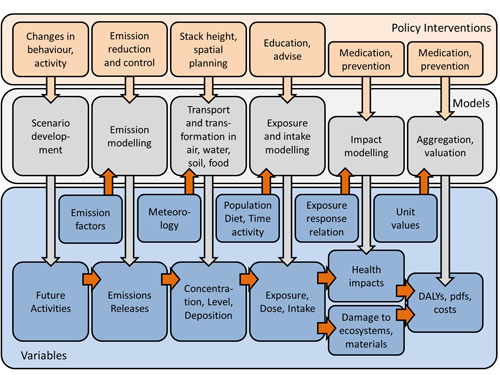
Two emission scenarios are needed for each calculation, one reference scenario and one case scenario. The background concentration of pollutants in the reference scenario is a significant factor for pollutants with non-linear chemistry or non-linear dose-response functions. The estimated difference in the simulated air quality situation between the case and the reference situation is combined with exposure response functions to derive differences in physical impacts on public health, crops and building material. It is important to note, that not only local damages have to be considered - air pollutants are transformed and transported and cause considerable damage hundreds of kilometres away form the source. So local, European wide and hemispheric modelling is required.
Regarding dispersion, with NewExt, not only atmospheric pollution is analysed, but also pollution in water and soil. Human exposure to heavy metals and some important organic substances (e. g. dioxins), which accumulate in water and soil compartments and lead to a significant exposure via the food chain, is represented in further models.
As a next step within the pathway approach, exposure-response models are used to derive physical impacts on the basis of these receptor data and concentration levels of air pollutants. The exposure-response models have been compiled and critically reviewed in ExternE by expert groups.
In the last step of the pathway approach, the physical impacts are evaluated in monetary terms. According to welfare theory, damages represent welfare losses for individuals. For some of the impacts (crops and materials), market prices can be used to evaluate the damages. However, for non-market goods (especially damages to human health), evaluation is only possible on the basis of the willingness-to-pay or willingness-to-accept approach that is based on individual preferences. The monetary values recommended in ExternE by the economic expert group have been derived on the basis of informal meta-analysis (in the case of mortality values) and most recent robust estimates.
ExternE reports
- Bickel, Peter und Friedrich, Rainer (eds., 2006): Proposal for harmonised guidelines for the integrated assessment of transport projects in Europe; Universitaet Stuttgart; http://dx.doi.org/10.18419/opus-11958
- External costs of energy and their internalisation in Europe, Seminar, Brussels, 2005, presentations available for download as a zip-archive
Completed projects applying and enhancing the ExternE methodology
|
URGENCHE EXIOPOL IN-STREAM NEEDS HEATCO NewExt GARP II |
(2011-2014) (2007-2011) (2008-2011) (2004-2009) (2004-2006) (2001-2003) (1996-1998) |
Past ExternE Projects
|
Core |
NewExt |
|
National Implementation |
DIEM |
|
Transport |
ExternE-Pol |
|
Core/Transport |
MAXIMA |
Past Projects using ExternE Methodology
|
GreenSense |
SusTools |
|
ECOSIT |
RED |
|
AIR4EU |
MARQUIS |
|
MERLIN |
STAREBEI |
The project ExternE = Externalities of Energy launched in 1991, financed by DG Research within the Joule programme. The main scope at this time has been the airborne pollutants from power plants and the development of the impact pathway approach.
Follow-up projects of this first ExternE phase have been going on up to now. There main goals have been on the one hand improving and extending the methodology and incorporating new knowledge, on the other hand extending the field of applications, such as heat production, transport, and industrial activities.
Thus, the whole ExternE study is in fact the result of more than 20 research projects conducted in the past 10 years. Researchers from all EU Members States have taken part. The Commission contributed EUR 10 million.
The main organisations and leading developers of this approach are shown in the following - with links to their website..
- Institute of Energy Economics and the Rational Use of Energy (IER), University of Stuttgart
- Centre d´Énergétique - Ecole Nationale Supérieure des Mines / ARMINES, Paris, France
- Department of Economics and International Development, University of Bath, Bath, Great Britain
- Institute of Occupational Medicine, Edingburgh, Scotland
- Vlaamse Instelling voor Technologisch Onderzoek NV (VITO), Mol, Belgium
- AEA Technology (formerly ETSU), Didcot, United Kingdom
- Institute of Terrestrial Ecology (ITE), Cumbria, United Kingdom
- Research Centre for Energy, Environment and Technology (CIEMAT), Madrid, Spain
- Centre d'étude sur l'Évaluation de la Protection dans le domaine Nucléaire (CEPN), Fontenay-aux-Roses, France
- Swedish Corrosion Institute (SCI), Stokholm, Sweden
- Instituut voor Milieuvraagstukken (IVM), Vrije Universiteit Amsterdam, The Netherlands
Beside these main organisations listed several other teams have participated, especially during the National Implementation phase.